A Call to Commit to the Craft of Service
Defining the service we give to our guests in the same way we do our cheese, bread, and coffee
Sometimes things come together for me in strange times and unexpected ways. Some of those ideas melt away over time and lead to very little. Others play out very positively. What follows is new, and I don’t know where it will go. In the spirit of sharing thoughts and uncertainty, I decided to put it out there.
What’s been on my mind is something of a quiet coming together of two subjects to which I’ve long been deeply committed: craft (aka “artisan”) production and customer service. Though we’ve been dedicated to providing an exceptional service experience and serving full-flavored, hand-crafted food and drink for over four decades now, I had not really put the concepts together in this way up until last week. Since then, the connection between the two has been going around and around in my head, getting stronger with each passing day. So much so that I decided to stick my neck out and share the unfinished and not-fully-formed idea:
-
What would happen if we start thinking about mastering and making our customer service happen with the same seriousness and commitment to craft?
-
And, would it be helpful to start actually calling it out that way, both for ourselves and our customers, to make it clearer what we’re doing and also to hold ourselves effectively accountable?
The connection between craft and customer service began, as many good things do, with humility. As I wrote last week, I was heading west to Portland to give a talk on the subject at the annual American Cheese Society conference. ACS has long been one of my favorite professional gatherings of the year, and I’ve been going pretty much annually since the late ’80s. As I was thinking through the talk on the way there, it dawned on me that one of the reasons I love going is that it is a very humble group. As per the words of the wonderful writer and teacher Edgar Schein who I referenced last week, as a rule, the members of the group are “committed to being helpful, bring a great deal of honest curiosity, and have the right caring attitude.” If you’ve ever presented in public, when you have a humble group who’s bringing those three things to their side of the conversation, it’s highly likely things are going to go well—as I believe they did with this talk. Thank you to those who were there.
In the spirit of finding the sweet spot between the rhythm of our ego and the counter-rhythm of our humbleness, I started to think about how that same groundedness and good energy is what I experience in the cheese of the artisans, wholesalers, and retailers who attend this conference each year. While all of us need to make a living, I seriously doubt that anyone there (including me) started working with artisan cheese to make a lot of money. To the contrary, nearly all do it because they love the work and care deeply about the products they make or sell; because it’s become their vocation; because they believe their work is making a positive difference for the land; and because they believe it matters for their families, for their companies (many of which are very small), for their customers, and in the process, for themselves as well.
Reflecting after the talk, I realized that the contrast between mass-market cheese and the hand-crafted offerings the folks at ACS make is much the same with customer service. Just as most modern grocery stores are filled with industrially-made, low-cost but consistent (and, I will say, low flavor) cheese, so too, is the world of customer service now dominated by the mass market equivalent of processed cheese. It serves a purpose, but it’s not great service. By contrast, everyone reading this can pretty quickly call up images of beautiful craft beers, craft-roasted and hand-brewed coffees, artisan cheese, and artisan bread. Done well, we all know that these craft offerings have a higher quality level, greater complexity, and reflect a way of “making” that honors the ecosystem—more flavorful and usually more healthful products, made by people who are super passionate about what they’re doing. They are most often made in commercial volumes—people make their living from them—but are done with a level of care that is way beyond mass market alternatives.
All of which got me thinking. If we call out craft beer and craft coffee, then why can’t we also call out—and commit to—craft service? If you’d rather imagine it as “artisan service,” that’s fine too; the two terms are used pretty much interchangeably in our end of the food world. The key for me is that naming it changes my own approach, and alters the mental images that arise, because, as Margaret Wheatley writes, “To name is to make visible.”
The more I think about it, the more the idea resonates. As I’m imagining right now, “Craft Service” is a much clearer way to call out the kind of service we’ve always been committed to here, but have not necessarily had a name for. The important thing to me isn’t really the name, but at the same time, I’ve learned a lot over the years about the power that names have. The book I wrote about it many years ago, Zingerman’s Guide to Giving Great Service, gets into all the how-tos of making it happen, but in hindsight, now I’m wondering if Craft could be a better way to frame it than “Great.” It’s true that we call our training “The Art of Giving Great Service,” but I’m reflecting now that, for me at least, imagining something as a craft calls up images of the importance of regular repetition, or years of working at mastery, and of acknowledging inevitable imperfection while seeking inspiration.
Craft Service, as I imagine it, could help companies steer clear of the transactional approaches that are the hallmark of mundane, mass market service. Just as we would want to determine whether we want to work with industrial cheese or hand-crafted alternatives, this idea pushes me to be clearer in my communication, both to customers and new staff coming in. Craft Service allows us to elevate and differentiate our work more effectively and it helps us appeal to new applicants and trainees. It’s an overt appeal to excellence, to passion, to vocation, to mastery. Craft Service, as I’m thinking about it here, is a call to all of us—starting with me—to push ourselves to ever higher heights of mastery. To care and commit, to dig deeper, to pay close attention to every small detail in the spirit of the Irish idea of Silver Branch Perception that I referenced in last week’s piece on humility. Craft Service (again, feel free to come up with your own term) seems aligned with singer-songwriter Claire Cronin‘s framing: “A poetic phrase [that] comes closer to the truth than a simple recitation of the facts.”
In the spirit of curiosity, what came to my mind next was a question: “What exactly is craft?” Joyce Lovelace, editor Craft Magazine, says, “Let’s face it, ‘craft’ is a curious word. We think we know it, but do we?” I realized that I didn’t, so I started to study. Webster says craft means “to make or produce with care, skill, or ingenuity.” I like the work of author, curator, and craft-historian Glenn Adamson, whose new book, Craft: An American History, came out back in January of 2021. Adamson’s approach is fascinating to me—he takes the time to look at things with new lenses. He works in the creative overlay between craft, design, curation, and a couple of other intriguing fields of study as well. Adamson defines craft as “skilled making at a human scale.”
Adamson is adamant that craft is best imagined not as a noun, but rather as an actionable activity, a verb. “Craft,” he writes, “only exists in motion.” Which fits well for this imagined melding of craft and customer service. Service isn’t just what we think about—it’s something we need to do! Craft, as Adamson frames it, and as I’ve experienced it, is rarely easy. Craft, Adamson says, is meant “to be hard-won rather than stumbled across as if by magic.” That makes sense to me—customer service is something that we master only by working incredibly hard at it over long periods of time at high levels of attentiveness. As Adamson says, “craft involves a considered consciousness about matters of execution.”
Does a new name make any difference? I guess I’ll find out as I explore. For some, it won’t matter at all. For me, in the short time I’ve been pondering this, I do believe that everyone who’s interested will understand immediately that anything made by a skilled craftsperson will be of far higher quality than a comparable offering made for the mass market in an anonymous factory. In the same way that we all have very different expectations for artisan cheese—we expect it to taste better, we expect it is made with radically more care, and we expect to pay more for it. We know that we could easily go down the block and buy something less costly that’s been made en masse by machine. We choose craft because we believe in it, we want it, we value the work that goes into it, and we appreciate how we feel after we’ve had it.
To be clear, I’m not suggesting that “Craft Service” is likely to be any different in content from what we’ve been working so hard to do here at Zingerman’s for over 40 years now. It’s just a way to talk about it that sets it apart. So, I’ve started to see that Craft Service would help us to differentiate, define, refine, and reframe our work more effectively. And to help us raise our own bar even higher on the effectiveness with which we serve you all every single day. I’m certainly not suggesting that anyone do what Glenn Adamson refers to as “craftwashing”—where people pretend to be craft, mostly by marketing their products that way, all the while continuing to do industrial, mass production. Marketing with dignity, as I wrote a few weeks ago, clearly precludes that. Craftwashing would be wholly inauthentic and the opposite of what we have been about since we opened in 1982.
One person who comes to mind in the context of craft is the letterpress printer Amos Kennedy. I met Amos for the first time many years ago through the Southern Foodways Alliance. I loved his posters, his personality, his down-to-earth wisdom, and his wonderful, socially-provocative wit. I bought a handful of posters and brought them home. Then one day at the Roadhouse, many years later, I saw someone who looked really familiar but couldn’t quite place, having dinner with a woman I knew. It was Amos Kennedy, wearing—as he has every time I’ve seen him—his coveralls over a button-down, oxford-cloth shirt. He has a wonderful energy about him, energy that, in my experience, is always exuded by people who are living their lives well, being true to themselves, and making their creative, craft-focused mark. Reflecting on what I wrote last week, Amos Kennedy hits the sweet spot between rhythm and counter-rhythm; authenticity comes through in everything he does. He works skillfully within the bounds of his craft, putting his personality effectively and energetically into all he does. Of his approach to his printing work, Amos says, “In the moment is creation. Creation is within every human. We must celebrate our creativity. The moment fuels our creativity.” And in this context, our craft.
Thinking about Amos Kennedy reminded me that around the same time I first met him at Southern Foodways, I had come close to making this connection, but hadn’t quite put it together as clearly as I did last week. It’s in an essay in Part 1, entitled Secret #10, “A Question of Systems,” which stresses the importance of … you guessed it, “craft systems.” Service, as I wrote in the essay all those years ago and have long taught, is a classic example of a “craft system” in action. The piece in Part 1 was inspired by an article in Harvard Business Review called, “When Should a Process Be Art, Not Science?” by Joseph M. Hall and M. Eric Johnson. The article, which came out in the winter of 2009, broke out four sorts of systems:
Type 1: Broken Processes
Type 2: Mass Processes
Type 3: Mass Customization
Type 4: Craft Systems
There’s more of my take on each of the four types of systems in Secret #10, but my focus here is on Type 4 and the idea that is now, nearly 15 years later, coming particularly clear in the specific context of customer service. And, in the spirit of what I’m writing about here, it was perhaps most helpful because it gave me a name and a category with which I could both think and talk about what I’d already been experiencing but had a hard time conveying to others. Ever since I read the article and wrote the piece, the concept of “Craft Systems” has been incredibly helpful to me in framing the work we need to do every day:
[The] last of Johnson and Hall’s four types really made me smile. The question they posed is, “When does a well-designed system need to be both systemically sound and still artistic?” … And the answer is:
When we have a sound system. … well-trained people, and so many variables that you can’t guarantee consistency, then what we have here is what the HBRers call an “artistic system.” I’ve switched that up slightly to call it a “craft system,” because “art,” as I’ve learned the term, basically means you can do whatever you want as long as it’s creative and inspired. For us it’s not all art: there’s actually a big need for good science and solid systems work.
This first line is what clicked for me this week:
Craft systems are, I think, exactly what we do in all our service work here at Zingerman’s. … We want to standardize as many parts of the system leading up to the customer interaction as possible. And we want to prepare our staff members to handle all of the various sorts of service situations they may come up against. But once the staffers actually go out on stage, we have to rely on their ability to adapt, to use their insights, and to make great things happen all on their own. …
In this context, our 3 Steps to Great Service and 5 Steps to Handling Customer Complaints (see Zingerman’s Guide to Giving Great Service for details) provide a broad framework, but they don’t even attempt to script out entire conversations. Instead, they give effective, well-thought-out, and well-practiced guidelines: the kind of flexible structures (what we refer to as “organizational recipes”) that prepare our staff members—i.e., the craftspeople at the end of the system—to use their expertise and insight to get to great results.
How would this approach help? For one thing, I believe an overt commitment to Craft Service could help all of us avoid getting pulled into the middle of the road, under pressure to use technology or efficiency to streamline and reduce cost. You, and I know I, have likely experienced it any number of times in the last few weeks. It’s when we call places at which we are customers and we get long, incessantly annoying (my judgment) auto-answers. This is the opposite of “skilled making at a human scale.” Theoretically efficient and low cost, but sorely lacking when it comes to the complexity, full flavor, personal touch, and connection to places that we properly associate with artisan, craft products. I love what musician Rosanne Cash writes:
Craft is the dovetailing of discipline and imagination, dedication and inspiration. When those spiral around each other, and serious attention is given over to that alchemy, then one’s craft can be realized. My particular craft uses notes and words, and sometimes they are difficult to wrangle into a pleasing shape, but no more difficult than thread and fabric, wood and knife, canvas and paint, flour and butter.
When I think of “Craft Service” in action here at Zingerman’s, there are thousands of examples that come to mind. Roadhouse staff who write thank you notes on to-go boxes, Mail Order service staff who write back to guests long after the order shipped, the Bakehouse making it possible to somehow get our hand-crafted Hungarian cakes and tortes to the Mississippi wedding of a woman who grew up in Ann Arbor—for whom having those cakes will make the celebration beyond-special. The work that I keep coming back to, though, that I really believe exemplifies this kind of craft work in action, is what Jenny Tubbs does when you order books from Zingerman’s Press. She’s been artfully giving amazing service here in the ZCoB for 24 years now. When you order a book, she could simply put it in a box with an invoice and send it off. It’s how I get dozens of books delivered to my house every month. Instead, Jenny very often takes the time to write a note, or to gift wrap the books. Sometimes she puts in a surprise. I know this only because I get gleeful notes of delight from many of you who have been the beneficiaries of this great work.
You could clearly call this, as I’ve been doing for decades, “great service,” or also “artful service”—both certainly make sense. In my head right now though, the idea of framing the work as a craft is connecting in a new way. It pushes me to study, to practice over and over again, to elevate every interaction so that I will be more and more effective at working with dignity and humility every day, to make every single experience exceptional in the way Jenny does so well with the books, or Amos Kennedy does with his prints. (As he points out, even though he might print 100 of the same poster, each one is slightly different!) It also gives me a way to explain to others in business what it is that we do more quickly and effectively than I have been.
When I think of craft, I think too of my longtime friend (someone else I met many years ago at the Southern Foodways Alliance symposium), Natalie Chanin. Natalie and the crafters who work with her at Alabama Chanin make beyond-beautiful, hand-sewn clothing, tablecloths, and a whole array of amazing artisan offerings in her workshop in northern Alabama. What Natalie says about craft is completely congruent with how I think about customer service here at Zingerman’s:
I’ve come to believe that craft, making, and creative endeavors toward producing sustainable products will create an enduring future for our community. … Craft is designing, making, and building something that provides value to your life or someone else’s. Value can mean many things: happiness, usefulness, function, self-worth. Craft is an intrinsic expression of life and creation.
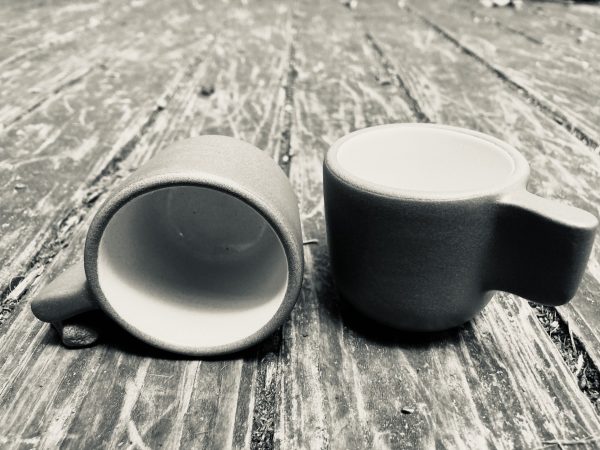
Heath Ceramics is another small company dedicated to craft that inspires me. Not surprisingly, Robin Petrovic and Cathy Bailey, who bought the company from founder Edith Heath back in 2003, are good friends with Natalie. I met Robin and Cathy I think back in 2010 after teaching ZingTrain in the Ferry Building in San Francisco where they have a shop. We went on to do ZingTrain work with them to help them write a couple of long-term organizational visions. They’re terrific people and I love their work—the espresso cups in the photo above are theirs. We use their plates with the traditional Korean foods Ji Hye and crew cook at Miss Kim, and we eat off of Heath plates at our house as well. They talk about their craft work as being:
Transparent and honest, with nothing to hide, and everything to celebrate—we make products in our community. In a human-scale factory, blending hand and machine. Human-scale means we’re grounded and relatable, neither too big nor too small. It means we celebrate process, material, and the people and places behind the products we make. This reminds us that we’re human. And maintaining humanity means a great deal to us.
Take out “products” and put in “service” and, for me at least, it fits really well. Robin says: “We always leave room for the touch of the hand. The touch of the hand leaves room for imperfection for surprise and for experimentation … it’s important on a couple different levels. It’s beautiful. There’s beauty in each piece.” And that same beauty, I believe, comes through when we do our customer service work really well. It is helping me imagine how to practice and teach this more effectively.
I realize that without having named it, our commitment to what I’m calling Craft Service here is a big part of what has helped us to do what we’ve done over the last 40 years. Giving Craft Service when you’re a tiny start-up, especially when the owner is on-site and the staff is small—isn’t all that hard. But sticking with it when one grows is increasingly challenging. Most companies give up—instead, they start to make Craft Service into what Hall and Johnson call a “Mass Process.” When these companies give up, they write customer service scripts, they require staff to ask permission to do pretty much anything, and they remove the personality to avoid “problems.” Others opt to outsource their call centers altogether. Even worse, people now push everything into phone trees and computer-recorded “conversations.” Holding to what for the moment here I’m calling Craft Service work at the size of Mail Order’s holiday phone staff is no small achievement. Does it cost more? Sure, in the same way that the products we sell also cost more. But like the bread, brownies, cheese, olive oil, etc. that we ship so much of, the service stands out. It’s real people humbly having real conversations—conversations in which the small imperfections like the products of Heath Ceramics might well just be part of the beauty. It is the practice of Glenn Adamson’s “skilled making at a human scale” by a holiday-sized Service Center team of about 100 people.
In the end, it’s the content and quality of the work that matters most, not the name. But for me, giving it this name has shifted my thinking. Glenn Adamson writes, “A central theme in my work has been modern craft: the application of skilled making to the world around us. … I have argued for the crucial importance of artisanal values to modern life.” The more Craft Service there is in the world, the better that world is going to be.
Part of approaching service as a craft is that it elevates the work. So many folks providing customer service have been trained with a factory mindset: “Answer questions,” “Follow the procedure,” “Fill in the blanks,” or maybe, “Call the manager.” Approaching it as if you’re making an Amos Kennedy print, a set of Heath Ceramics plates, or one of Natalie Chanin’s hand-sewn shirts, for me at least, changes the mental model. Everyone would need to have their own images—these are just ones that resonate for me. The point is simply that mentally elevating every service experience to that level, thinking of oneself/myself as a world-class artisan in training, for those who are willing and interested, could make a meaningful difference.
That difference, I believe, isn’t just for the guest or the client. When we do service well, when we come at it with an effort to be master craftspeople, the work changes us, makes our lives better as much as, or even more than, it improves the guest’s. Amos Kennedy says it beautifully: “One does not master the craft. The craft allows you to master yourself. The craft makes you a better human being.” What we hope to get is very much I think what Maria Shriver wrote about her Sunday Paper enews this past weekend:
What I’m hopeful that you find here is a place of belonging. I want this … to be a place of hope and acceptance. I want it to be a place devoid of judgment, a place where you can learn something new from the many wise, reflective thinkers who write here. I want you to have your mind activated and your heart opened.
And when we deliver Craft Service as I know we can do, that is exactly what happens. Hearts are opened, everyone is honored for who they are. Diversity and dignity are welcomed into our daily work. And the lives of all involved are made better and more beautiful in the process.
P.S. We have Zingerman’s Guide to Giving Great Service in Spanish translation, too!
P.P.S And for hands-on teaching, check out ZingTrain’s “The Art of Giving Great Service” seminars.
Want more from Ari?
Sign up for Ari’s Top 5 e-newsletter and look forward to his weekly curated email—a roundup of 5 Zing things Ari is excited about this week—stuff you might not have heard of!


