The Impact of Art and Artfulness in Life & Business, Part 2
This is the second part of our interview with Ari Weinzweig, the co-founding partner of Zingerman’s Community of Businesses appears in the March-April 2018 issue of the Zingerman’s Newsletter. You can pick up your copy at any Zingerman’s business or read it online.
ZINGERMAN’S NEWS: You write a lot about Robert Henri in the Epilogue. How did he factor into this equation?
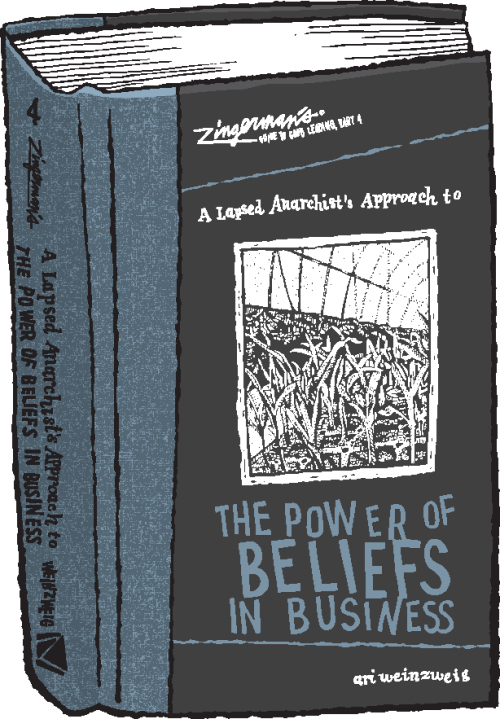
ARI: As I wrote in the essay, I’d never heard of Henri until a few years ago while I was working on the Beliefs book. Now I know that in certain circles he’s pretty well recognized, but he’s definitely not mainstream. He was one of the leaders of what’s known as the Ashcan School of painting and he taught art extensively in New York City, including at the anarchist Ferrer center. His book, The Art Spirit, was recommended to me by a reporter who’d heard me speak and said she was sure I’d like it. She was right! I totally loved it! He wrote it in 1923. The lessons in the book are mostly taken from the art classes he for so many years. In the same way that Brenda Ueland’s book from 1937 did, If You Want to Write, it blew my mind. Because both books, while they’re written about painting and writing respectively, are really about a way to live. Henri said, “I am interested in art as a means of living a life; not as a means of making a living.” And that’s really what this concept, the Epilogue in Part 4, is about. Living life artistically.
ZN: Does all this mean a free for all? Everyone in a business creatively just does what they want?
A: No. Not at all. In a team setting like a business we need structures and processes in order for things to operate effectively. The keys are that we give people the chance to help design those processes, and the understanding that there’s a lot of creativity that can—and ideally does—go into the design of systems and structures. When we do our work well, the design of effective processes, programs and structures is helping most everyone who works here to develop their creative abilities and energies. The better one understands how do that work the more you have room for creativity. Picasso challenged us to, “learn the rules like a pro so you can break them like an artist.” Duke Ellington said “it’s good to have limits.” Positive structure and consciously chosen limits can help create some amazing art. And great work, as well. They actually enhance this whole thing by getting the people in the organization to collaborate, to care and to tap their own creativity. I think our 3 Steps to Great Service, 5 Steps to Handling Complaints, Visioning process, etc. all do that remarkably well. There’s no limit, really. Like Maya Angelou said: “You can’t use up creativity. The more you use, the more you have.”
ZN:How does the visioning process you teach at Zingerman’s fit with all this?
A: I think it’s a fantastic tool. For everyone! Because I really believe that in our hearts, everyone has creative dreams and desires. It may be to be a great parent, or paint, or play polo really well – we all have them. But so often we get taught by society or our family or our friends that what we want is impossible, or at best impractical, and then to bury it. And then we end up cutting ourselves off from our spirit. The visioning process—most especially the hot pen approach where you just keep writing straight through without stopping—is one of the best ways I’ve ever encountered to help us get at those dreams.
The visioning is a perfect example of a process or guideline that helps bring out our creativity. The structure itself is designed to encourage us to live artfully and mindfully. And it works! It’s like writing down a waking dream, without allowing ourselves time to overthink things and hide—even from ourselves—what we really want. That’s the creative act, the art spirit that Henri has us thinking about. Basically, it’s what John O’Donahue said: “Your soul knows the geography of your destiny. Your soul alone has the map of your future, therefore you can trust this indirect, oblique side of yourself. If you do, it will take you where you need to go, but more important, it will teach you a kindness of rhythm in your journey.”
Visioning is all about artful work. Whether it’s your personal life, your work, your business, your seven-year old’s birthday party or anything else, it gives us the chance to design the future of our own choosing. Actually, let me rephrase that. We always have the chance; the visioning just makes it much more likely that we’ll take the chance we already had and put it to good use. Visioning is an active design role, not choosing from a multiple choice set of options. It’s not a treasure hunt or a lottery ticket. It’s an active act of creation.
Visioning is also helpful because once we’ve written it and decided on it, it can really help us hold course, to stay true to our art, in this case, when people start throwing other opportunities at us. Tim Ferriss said, “Once you reach a decent level of professional success, lack of opportunity won’t kill you. It’s drowning in ‘kinda cool’ commitments that will sink the ship.” I agree. Having a vision for your business or your life helps one turn down offers that, on their own might be perfectly fine, but are out of alignment with where we really want to go.
The visioning process is very helpful in bringing out our intuitive insights and ideas. They’re usually the things that we know others are going to roll their eyes at so we bury them or hold them back. But a lot of times there’s a lot to them. They’re things that can’t be proven in the moment. I don’t mean data doesn’t matter. But even with data, creative ideas usually emerge from someone looking at the data differently than everyone else, experiencing it in a different way, and then coming away from reading it with new connections and new ideas. In other data-based, scientifically-centered breakthroughs are still about an artistic approach to what one is working on. It’s what 19th century French mathematician Henri Poincare pointed out: “It is by logic that we prove. It is by intuition that we discover.”
ZN: Do you think you can tell the difference when you encounter someone who’s got “the art spirit?”
A: Absolutely! I think you can feel it in like six seconds. People are drawn to the artistic creative energy of people who are living a life that’s true to themselves and are making something special in their lives. It’s the same when you walk into a business like that. There’s an energy about it. I experienced it a few weeks ago when I went to teach ZingTrain at a little clothing company in Nashville called Elizabeth Suzann. It was started six years ago by Liz Pape in her attic. Now they have about 40 employees. She designs women’s clothing and it’s all sewn in their space using only American cotton. The designs are exceptional. But the energy of the staff is completely congruent with the beauty, down to earth elegance of the designs. Wendell Berry writes about the difference between thinking of a workplace as a factory where you produce something as opposed to thinking of the workplace as a place to be alive. I think when we’re tapping our creative originality, being true to ourselves, that’s what happens. Certainly, Liz and her husband Chris and their crew are doing that.
Paul Hawken said, “A successful business pulls you towards it.” I agree. The energy is engaging. You want to enter. It’s how it feels at Heath Ceramics where I’m going to be this weekend doing a book event. Their ceramics are beautiful. There’s something special about the feel of them, the look of them. And you feel the energy as soon as you walk into their space. Kudos to Robin and Cathy who own it and everyone who works there. We use their plates and bowls at Miss Kim, by the way!
I think it’s all evident in people’s energy. I love what John O’Donahue said in his very Irish way: “When the talking is talked and the doing is done, everything depends on the integrity of your own presence…it’s lovely to sit in front of someone who is themselves.”
It’s pretty palpable. Robert Henri wrote that, “The coming into the presence of a piece of art you truly love causes a tremendous revolution to occur in you.” And, “When the artist is alive in any person, whatever his kind of work may be, he becomes an inventive, searching, daring, self-expressive creature. He becomes interesting to other people. He disturbs, upsets, enlightens, and opens ways for better understanding. Where those who are not artists are trying to close the book, he opens it and shows there are still more pages possible.” I hope that’s what we do here at Zingerman’s. We’re far from perfect, but that’s really kind of the point in my mind.
When it really comes together—making peace with oneself and one’s art—I think there’s a grounded calm about people’s spirit. At Zingerman’s we’d say “their vibrational energy is very good.” It’s interesting. I’ve kind of known that for a long time. But I hadn’t really thought about the bigger implications until I was reading Stephen Pressfield’s book, The War of Art. He pointed out what seems really obvious now that I read it: “Individuals who are realized in their own lives almost never criticize others. If they speak at all, it is to offer encouragement. Watch yourself. Of all the manifestations of Resistance, most only harm ourselves. Criticism and cruelty harm others as well.”
ZN: Has this idea of living life as an artist made a difference for you?
A: It really has. I mean it’s not like I was living this robotic, dull life before I had this thought. Obviously, I’ve got a lot going on in really good ways. I feel super fortunate to have all the great people and food and opportunity that I have around me—many people don’t have access to all of what we have here in Ann Arbor, or the tools and support network that I have from our organization. But even so, just thinking this way, I pushed myself—or maybe the idea pushed me—to pay even more attention than I was already paying.
Really, even while I’m answering this question I realize I’m looking around the room trying to see what details I’d missed. I’m sitting at the counter at Miss Kim…noticing anew the kind-of-but-not-quite-round shape of the paper lamps above the bar; server Terance (yes, there’s only one “r” in his name) Gordon’s braids, his beard, his posture, his grounded energy; the art on the walls that was lent for this month by a painter named Paolo Pedini, and the colors of his work and how the one over my left shoulder has three old slides—like from a slide projector—embedded in it. If I’m really paying attention, I could go on for hours without even leaving my seat. It’s all interesting, it’s all beauty and joy and it makes life so much more fun, more rewarding. And it opens so many opportunities to recognize the great work of others and to be able to appreciate and support them more effectively than if I proceed mindlessly.
I can say pretty confidently that it’s pushed me to take more care with every action. To try to bring even more love and grace and meaning to every tiny thing. Pushed me even more than I already pushed myself to not take anything or anyone for granted. To be even more appreciative than I’d already worked to become. And the cool thing is that, in a good way, I can be much better at all of it still. Robert Henri said, “Of course it is not easy to go one’s own road. . . . After all, the goal is not making art. It is living a life. Those who live their lives will leave the stuff that is really art. Art is a result. It is the trace of those who have lead their lives.” I hope that’s true for me and for our organization both. Approaching the building of our business as a work of art has made my own work infinitely more interesting. I hope it does a small bit of the same for you. At the least, it might help you stay young. As Kafka wrote, “Anyone who keeps the ability to see beauty never grows old.”


