
The Spicy Side of Zingerman’s
Ari talks to Montreal’s Spice Trekkers, Épices de Cru
Three years ago last summer I had the pleasure of being up in Montreal for a conference. It’s a great city to visit. “It’s as close to Europe as you’re going to get in North America” is a pretty common refrain from many folks I know. As I do everywhere I go, I snuck out of the conference for a bit, took a taxi out to the Jean-Talon market and started to explore. It was thriving, alive, full of families; locals and tourists both worked their way through the stalls. A bit of cheese, a couple of bakeries, some maple syrup producers, a great frite stand, and of course plenty of locally grown fruits and vegetables. But the most memorable bit of the morning came when I walked up to this little spice shop. Even from the street it looked great. Ever curious, I went in. It turned out to be one of the highlights of the whole trip. I’ve been to a lot of retail spots and restaurants over the last thirty years. I can usually tell you in about two minutes what the business is like based solely on the energy I experience upon entering the building. Épices de Cru, it was clear almost immediately, was pretty excellent. It was alive, buzzing. It looked great and it smelled even better.
We haven’t historically done a ton of work with retailing spices over the years, but it was everything I would imagine a Zingerman’s spice shop might be if we had one. The staff was engaged. The energy was excellent. The aromas were amazing. Everyone was talking spices, smelling spices, sharing stories of what one could cook with them. People were smiling and laughing. Some folks (like me) were clearly from out of town. Others looked like regulars—coming to score a tin or two of some spice blend that they clearly counted on for their everyday cooking.
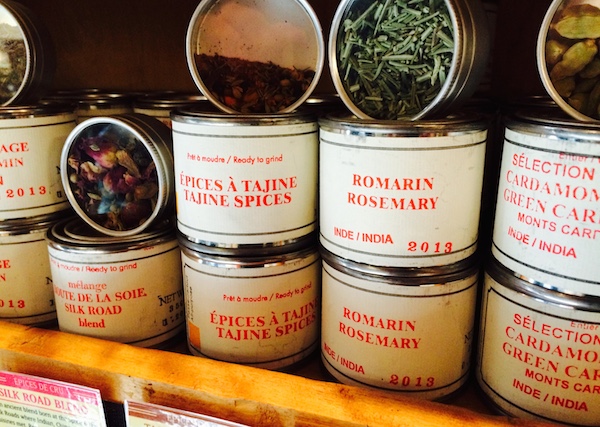
Perhaps most exciting of all was listening to the staff tell the story of where each spice came from, the region, the town, and often, the family that grew it. I felt strangely at home—it was, as I said, a lot like being in the Deli. When customers asked a question, staffers would open a tin or jar (sound familiar?) so that their client could smell the spices. But they didn’t stop there—they would scoop a bit of whatever it was the customer was curious about into a mortar and pestle and grind it up right then and there. Which means that customers were experiencing the spices in their full potency—freshly ground, when all the essential and volatile oils were at their highest. I loved the packaging too—small tins with simple white printed labels that looked like they were stamped by hand onto the paper. You won’t be shocked to hear that I bought a bunch of stuff to bring home. Deep, dark, musky Kurdish red pepper flakes. A whole bunch of amazingly aromatic Tellicherry black pepper from a single estate in India. Wild pepper from Andaliman. I loved it all.
As excited as I was about the visit, I actually had little hope that we’d be able to get the spices to the Deli to sell. For reasons that are over my history major’s head, it remains very challenging to bring food over the border from Canada for commercial purposes. So I savored what I’d brought back, saved the tins, and filed the idea away. Impatient as I am, I’ve learned that making great things happen can take a long time. I’ve often spent years, even decades trying to figure out a way to bring products to Ann Arbor. So I kept the tins on my counter, and hoped that, one day, we would make something happen.
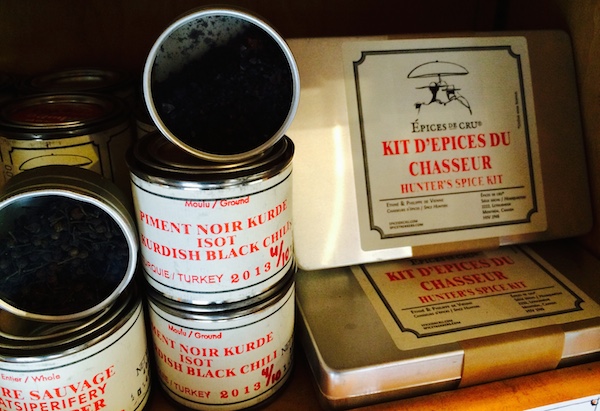
That day came last summer when I was at the Fancy Food Show in New York City. Walking through the show that Sunday afternoon, I looked to my left and saw a big display of those same fantastic little tins of Épices De Cru spices. I was immediately excited. Finding a treasure like Épices de Cru in its hometown was great. Finding it at the Fancy Food show made me smile—their presence on the show floor meant that the folks who owned it were ready and able to get their products across the border into the US. Four months later, I have a happy ending to share: we’re selling the spices of Épices de Cru here at Zingerman’s. And equally enticing, I’ve gotten to learn the story of the de Vienne family who started it, and hear all the amazing stories of the exceptional spices they’ve assembled from their world travels over the last thirty years.
While it’s only the beginning of what I hope will be a very long relationship, all our early interactions have been excellent. Those lovely little white paper-wrapped tins, filled with exceptionally aromatic spices are starting to show up on the Deli’s shelves and in our kitchens. Just in time for holiday cooking, entertaining and gift giving. But the best news is that once you try them, I’m confident you’ll be back for more. Just as we’ve all gotten hooked on great cheese, amazing olive oils, handmade breads, and incredible candy bars, it’s hard to go back once you’ve experienced spices of this caliber. They are fantastically flavorful. It turns out that my initial instinct, the intuitive feeling that I’d walked into something really special that morning in Montreal, has shown itself to be true.
To prove the point, here are a few snippets from Ethné and Philippe de Vienne’s book Spice Hunters. “Our culinary heroes are people who cultivate, harvest and cook with the best spices the world has to offer. We are profoundly committed to authenticity of traditional recipes. When we travel, we cook with—and live among—the people whose communities we visit. For the past thirty years this modus operandi has been our greatest source of information, inspiration and innovation.” This is clearly the same attitude and approach that we’ve taken here at Zingerman’s with every product we work with; go to the source , meet the people, study the culture, stay true to tradition. You can see why I was so excited to encounter Épices de Cru. The de Vienne family are clearly our spiritual and culinary compatriots.
What follows is an interview with Marika de Vienne, Ethné and Philippe’s daughter. Along with her brother, Arik , she and the family continue to travel the world sourcing spectacular spices, meeting the people who produce them, learning the culture and cuisine of the region, and then sharing all that with us! I hope that you’ll take a few minutes to smell some of their amazing spices, or perhaps to taste them in some of the dishes at the Deli, Bakehouse and Roadhouse. If you head up to Montreal, make time to head to the Jean-Talon market and say hi to Marika and her parents in person!
Ari: So what do you all do?
Marika: We travel the world looking for whole spices, authentic recipes, and traditional spice blends. That’s really our mantra. We go to different countries and start in the markets. We look at what everyday people are eating. Cultural gastronomy often happens through restaurants. But we look at what people are cooking at home.
Your parents started the business back around the same time we started Zingerman’s, right?
They did. My parents were actually caterers. The top caterers in the city really. And the more press we got, the more demand there was for our catering. We cooked everything to order, we didn’t cook anything in advance—we always cooked food fresh. Over time there was more and more interest in us catering larger and larger parties. We were getting requests to do events for over 1000 people. This was in the late 80s and catering at that time still mostly meant that someone brought a plate of chicken to your place at the table. And we were like “You can’t do our kind of fresh food for 2000 people from a temporary kitchen in a parking lot.”
So we started to look at cultures where they were used to serving banquets to a thousand or two thousand people, some times for three days straight. Places like India and China where they had big traditions of these huge banquet meals. What we had in common with them was that they used really great ingredients. But the other thing that they all did was to use a lot of spices in their cooking. Spices make for much more complex flavors. So we really explored the spices.
One advantage of us being caterers in Montreal is that in the summer there’s no catering to do, so we could travel for six weeks as a family. My parents, and my brother and me. And wherever we would go to visit we would find all these spices that you couldn’t find here in Montreal. Everything here was ground and not very flavorful. But we’d go to Trinidad or Mexico or other places and we’d bring back these amazing spices. My dad would share them with other chefs and that’s really how Épices de Cru started. We started trading spices with other chefs who hadn’t ever had anything like them but wanted them for their own cooking.
At that point we were still primarily caterers with good spices, not spice sellers. And then one day my dad went on a cooking show with a woman who turned out to be like the Oprah of Montreal. And then it exploded. People were calling us like crazy. But for a long time we resisted getting into the market. We didn’t want to be part of a fad. We wanted to be part of a movement. To teach people that for a very little money they could significantly enhance their cooking.
So you really know all the people who grow the spices?
A lot of them! We know many personally. We buy directly from growers, local traditional traders, coops, and then we have trained, trusted. local agents to do the buying for us in some places. There are still some spices that have become so commodified that they present a challenge. For now! Not all countries really can meet the romantic vision of a single family meeting all our needs. Every place has its own socio-agricultural systems that we have to work with. But we do know where the vast majority come from. We select them all personally and we have NEVER, ever bought from brokers. Our vision is that one day we can pinpoint where all our spices are sourced.
We’ve been buying nearly all our Mexican chiles from Fernando and Lucia Lozano for some time. They’re from the high Sierra Mixe in Oaxaca but they’ve become chile traders over the years and now they live in the city. Everyday of the week they sell their chiles in a different “tiangi” the traditional Native markets that are all over the Oaxaca valley. They are really classic chileros, buying and selling from the various Zapotec, Mixtec, and Mixe areas of Oaxaca. Their star chile is the pasilla de Oaxaca. They get it from the neighboring village of their birth at the highest point of the Sierra . The Pasillas have to travel four hours on horseback before they reach Fernando and Lucia’s village where there is a track passable by truck. We have never been to those high villages but we’re working on visiting for the 2015 harvest, which coincides with the Day of the Dead feast. Needless to say we’re completely worked up about visiting. Of course, first we have to get the permission from the village elders. Fernando and Lucia are working on that.
We love to tell the stories of the people we buy from. A lot of people don’t think that their story is interesting. But we tell them it is. We still depend on our interactions with our suppliers and travel. We’re like middlemen for our suppliers. When we get articles about us in the press all they want are recipes. We try to talk to them about the people and their story but they’re not interested. We fight tooth and nail to with the editors because they say that people just want recipes. And we say NO—people do want to know where these flavors come from.
When I talk about spices I rely on my own experience with that spice. Ultimately spices are a very personal thing—no one else tastes things exactly like you do. And then there’s the story of how we discovered each spice. There’s a story behind every single blend, behind every spice that we sell. There are human beings behind this, every step of the way. It’s always about their story. We love talking (as yo u can tell!) and sharing stories and it’s the wonderful story behind that makes it special.
Can you tell us a bit more about the business?
My mom is from Trinidad. She left there at 13 and her family went to Toronto but then pretty soon after that they moved to Montreal. My grandmother was really enchanted by the idea that her kids could learn French. She’s an amazing woman. She turned 90 at the end of September. She’s extremely wise and a very cool woman. She has the most amazing taste in food. I’ve never seen anyone who knows as little about food on a professional level but then has such amazing taste in food. My parents met because of my grandmother. My father worked for her here in Montreal and after a few years she invited him to dinner and he met my mom. Little did she know that they’d end up getting married!
My father grew up here in Montreal. He spent half his childhood in France and half here. My father is from a family of aristocrats from the center of France. They were horrified that my father wanted to cook. That was like a servant job. They were really from the upper crust. His mother couldn’t believe that her son was going to work behind a stove. But my mom really encouraged my dad. He has an amazing nose and an amazing palate. He has a real talent for deciphering these things. I’m more partial to Asia. My dad is more partial to Turkey, Indonesia and Mexico. I was born here and my brother as well. My brother’s ceramics are used in our stores for tea service. His collection is available in the Montreal Museum of Fine Arts shop.
So they’ve both been part of this from the beginning?
Exactly. My mom said “We’re gonna offer nothing but the best. I’m tired of companies starting with ‘pretty good’ but then going lower and lower in their quality. If Mother Nature doesn’t provide it we weren’t going to either.” When it comes to food, this is a family business. A lot of our employees have been here with us a really long time. Food is about sharing an experience. It’s the best way to start any conversation. Food and cooking really open people’s minds to possibilities. It’s a very non-threatening way to expose people to another culture. We do both. For us it’s all about doing it in a way that feels right and ethical. Sometimes we feel kind of alone and it’s nice to know there are others—like Zingerman’s—out there.
What are some of your favorites of the spices?
Cardamom! I use it in everything. It’s just a beautiful aromatic spice. It’s extremely potent. I’m the person who’s gonna sneak a cardamom pod into anything. I’m not usually into potent spices but I use cardamom in everything. In desserts, in chai. Ours comes from the Cardamom Mountains of India. A lot of what you find here is the Guatemalan cardamom because they produce so much. It’s fine but once you have the one from the Cardamom Mountains, you’ll never go back. It’s so much more interesting. I also like the Colombian variety of cardamom that we get. We’ve only had it about a year. It’s also a green cardamom but it’s distinctly floral. I would use that one for desserts, for cookies and cakes.
Another spice I use a lot is our Grains of Paradise. It’s from the same genetic family as cardamom. We get one that comes from Trinidad. This one only grows in the wild. Once you have these, the others you’ll try on the market are horrible. Ours are really potent and extremely floral. It starts with an intense heat and then this intense lavender flavor. They’re great with chocolate.
What about black pepper? That’s something I really crave all the time.
Pepper is my dad’s purview. He’s always on the search for great pepper. We’re always looking for the single source, the mono varietal. We have the Tellicherry. It’s been more popular in the States than here in Canada. We’ve had it since the beginning but in Canada no one knew it. It’s so aromatic. It’s got a nice heat.
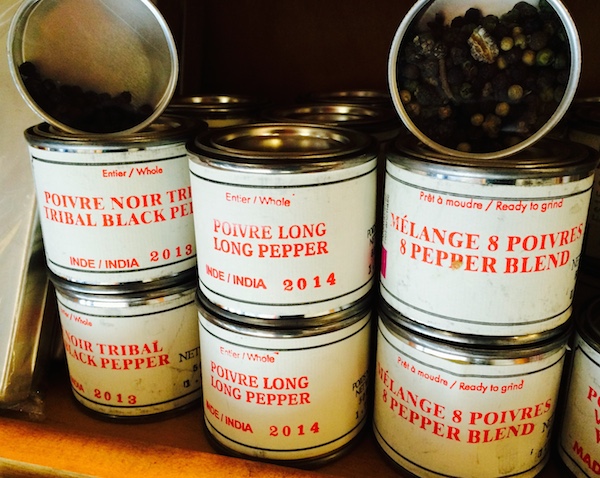
The one I LOVE is the tribal pepper. It grows on vines in a Tiger Preserve in India where it is picked by local villagers. So it’s literally semi-wild. There’s a heat to it that’s unlike any other black pepper I’ve ever had. It’s more like white pepper. It’s got the heat of white pepper with the flavor of black. I also recommend our 8-Pepper Blend. Most pepper blends are a waste of time because they mix white, black, green and pink and it’s silly. They don’t work well because the black and the white overtake the delicacy of the other two. But I still really wanted a pepper blend. I bugged my dad for years. But he didn’t like the idea. And then, literally, it came to him in a dream. He had the idea to add allspice to the blend. I love it. It’s one of the few original blends we have but because it has so many aspects it works with almost everything.
Then we have the black pepper that’s from Saji. It’s all from one man’s estate in India. My father insisted that it was so special that we needed to not just tell the story but put his name right on the label. He said, “it must be known because it’s that exceptional! “ It’s a little bit larger in size than most black peppercorns and very aromatic. He is still sifting the pepper completely by hand. There’s no big machines. They’re going through to sort it totally by hand, each grain, one by one.
How about your blends?
Almost all the blends we do are traditional blends in their home areas. We’re very committed to the traditional. The blend I love most now and I just love smelling is the Satay Spices from Indonesia. It’s amazing. It’s very heavy on the lemongrass and the cardamom. It’s hot. We didn’t cut it down—we reproduced it just the way we had it in Indonesia. You put it on chicken with peanut sauce and it’s very good. But you can basically use it on anything. It’s really fun!
Another great one is called Silk Road Spice. One year on vacation we wanted to really get away. So we decided to go the desert in China where we figured there won’t be anything to do with food. We get there and it’s Ramadan so we thought we were really off the hook. But we were wrong. It’s been a trading post for centuries. We’re walking through the market and we see this spice blend and its ground. And we realize it’s the blend they’re using in their pulled noodles and their lamb.
So we asked, “What is this called?” And they all just said, “It’s called “the blend!” So one guy in the market, we asked him what was in it, and he basically said, “That’s for me to know and you to find out.” We bought a kilo and my dad tried for like three months to reproduce it. After about two months he realized that he was restricting himself to the spices of the region. But we’d forgotten the obvious—this was a trading post so there were ingredients on the market that would have come from many other places. Once he figured that out, we had it. The blend has three different roses, anise, star anise, cassia buds. The authentic name was “the blend.” It’s great in desserts. I like to blend it with a black tea from Yunnan. The people in Yunnan thought that was crazy. In China they said only ignorant people would put spices in tea. It wasn’t my intention to mix it—usually we just like the traditional things but it was delicious. Everyone fell in love with it.
I love the Yunnan blend too, from China. I lived there for so long. It’s the first recipe in our book. It’s the one blend that you can just use raw. You boil some lettuce leaf and dip the cooked leaf into the spice blend and eat it. It’s delicious. It’s got black cardamom mixed in with three different chiles. You just dip the cooked lettuce in and you serve it with rice. One of the chiles is hot in the blend. And I love showing it because I don’t really cook. Cooking in our family is something that men do. For people who are afraid to cook, then this is for them. I just ask, “Can you boil lettuce? If you can, this is for you!”
I love the black curry too. It comes from Sri Lanka. The black curry has cumin, coriander and a bunch of other spices. All the spices are roasted for different lengths of time. The coriander is lightly roasted, the cumin is heavily roasted. And it has toasted rice in it. It goes really great with beef. Most people think of curry as yellow, but I just say “curry” means blend honey. We call it black and white night because he’s white and I’m not. We’ll have a black curry and we have a white curry with fennel.
What else should folks know?
It’s hard to describe what we do because it’s so organic and so normal for us. We love sharing. It sounds hokey. But at some point when I’m at the store and someone discovers some flavor that they’ve never had. And there’s nothing like that sparkle in someone’s eyes when they discover a new flavor. When I go back to those places and show them what we’ve done with their product. We’re so against the colonial attitude—we want things to go both ways and we want to share both ways. One of things that’s important to understand is that we don’t switch suppliers. Once we have someone whose product we love we stick with them. If the crop runs out we just wait for their new crop to come in. We don’t switch to someone else.
Are the recipes secrets?
Not at all. To the contrary. When we opened we only had 8 blends and they were all ones we were very proud of. We had a book on how to make your own. And we literally had the recipes and everything. And people were like, we don’t want that. We want to buy it. So it’s stayed a part of our ethics that we tell people exactly. If you want to learn that dialect of Mandarin and climb that mountain to get that chile, go for it. The growers need more business and it’s an exceptional product. And we want to help them succeed. Sometimes we have pay them for their losses because no one else will help them.
You don’t sell ground spices do you?
No! It’s against our mission. A lot of ground spices are cut with flour or powdered brick, ground up rice, etc. With us what you see with us is what you get. So we want people to see what we haven’t really altered the produce in any way. And that what we have in our tins isn’t changed in any way. Spices are delicate things. They have essential oils and volatile oils. As soon as you grind they will fly away. Even in our containers which will protect from light and humidity. Even if we ground in a can they only last in our cans 6 months. But because we’re buying really special crops we want them to be able to last as long as possible.What’s the point of traveling across the planet and then grinding it up and letting all those valuable oils get lost? It just seems like a crime.
The 2012 crop of Tellicherry pepper was phenomenal and we bought it all. It’ll keep six years in the right conditions. If we ground it might last 8 months. but this way we can keep it much longer. We had a customer come in like 8 months ago and she had a tin of our spices from nine years ago when we opened the store and they were still good. Kept whole and away from light and moisture. It just tastes so much better when you grind them yourself right when you use them.