
An Interview with Joel Kapp, Roadhouse Butcher
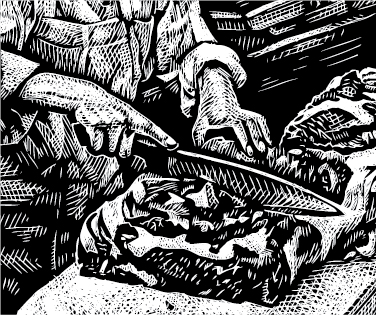 Ari talks meat with Joel at Zingerman’s Roadhouse
Ari: How did you get so enamored of butchery?
Joel: One of my very first jobs was at a little market in Chelsea, Michigan. It’s not there any more. But I loved it so much. I never, ever, ever was like “I have to go to work.” It was a butcher shop. They had some produce and some dry goods and stuff. It’d been there forever. We had great relationships with customers. There were all these regulars that came in all the time. It was like a conversation that continued for years.
A: So you’ve been around meat for a long time?
J: Yeah. I’m a meatasaurus. I probably eat more meat than I should. But I love it. I brought this in for you to look at. [Hands Ari a book.] It’s called The Hotel Butcher and Garde Manger and Carver; Suggestions for the Buying, Handling, Sale and Service of Meats, Poultry and Fish for Hotels, Restaurants, Clubs and Institutions. “An expression of the practical experience of one who has spent thirty years in all branches of kitchen, pantry and storeroom work; also as steward and buyer.” It’s from 1935. I love this book.
A: What do you think about the beef at the Roadhouse?
J: The meats are fantastic here. All of the steers we’re buying are out in the pasture the whole time. No feedlot beef. I think that we’re so incredibly fortunate to get the beef that we get in. Our meat supplier says that he hasn’t had beef this good come in this regularly ever. One of our family farmers goes out to 20 something farms and hand selects the animals. And he loads them up and works with them in the field. Making sure that the fields are being rotated properly. He does meticulous beautiful work. Better treatment of the animals too. I went down there and it was very refreshing to see that it was exactly what I was hoping for. I got to meet all the people who do the slaughtering. The holding pen lets them chill out and be comfortable for their last few days. When I visited they made sure that we were very quiet—even talking about them, they wanted us to move fifty yards away. They want them to be relaxed and not stressed out. Plus, we have 6 to 8 steer a year are coming off our own Cornman Farms in Dexter. It’s raised by us on Island Lake Road. Some of it comes to the farm from 4H auctions and we finish them the last 4-6 months in our fields.
A: What makes the difference between this beef and what other restaurants are serving?
J: Our dry aging program is pretty neat. It’s certainly a more expensive way to prepare and serve beef but the flavor’s well worth it. The dry aging . . . I like to use the analogy of cooking stock down to concentrate its flavor.
A: I often compare it to aging cheese. Does that make sense?
J: Yeah. The more moisture is lost the more you concentrate the flavors. We age the beef for burgers for two weeks. The flavors are already concentrated. With the steaks we continue to age up to about four weeks. I like ‘em a bit older even. But this is a good place to be.
A: And we’re only buying whole animals right?
J: Yeah, all the beef that goes onto the Zingerman’s Roadhouse menu is butchered in the back off the side. We don’t really buy boxed (pre-cut) beef the way most restaurants do. We’re one of the only places that’s buying whole animals. We work with the whole side of beef. We have a whole cooler for the aging. It could be bigger though! We’re serving so much.
A: Given the variability of the food business it can’t be that easy to manage the supply?
J: One of the trickiest parts of my job is to maintain a steady flow of meat. We use almost two steers worth in a week. We have to have burgers and barbecue all the time. So we have to manage the menu for all the other cuts. It’s kind of like a chess match.
A: What does the aging process do for the meat?
J: In the beginning the sides lose one pound or so of water a day. At that stage they’re about 700-800 pounds. The first week to ten days is when you’re losing the most. So by the time we get the beef, it’s been aged two weeks and it might have already lost nearly twenty pounds of weight. And then it keeps losing weight as we age it longer. After you’ve aged an animal the surface has to be cut off. So you lose that too.
A: What do you like about cutting meat?
J: It’s an art form for me. I really enjoy making things. I really enjoy taking something big, a side of beef that’s one big piece and then making all these beautiful steaks and cuts of meat out of it. I have a lot of fond memories of cutting meat from my first job at that market. It’s something that for me is comforting. I also really enjoy the logic puzzle that you have to be able to piece together what cuts to use in order to manage the menu and not have any waste.
A: So with all that work can you really taste the difference?
J: You really can taste the beef. You take a nibble of this and twenty minutes later you’re still tasting really good flavors. The burger is also a very tricky thing. There’s a certain amount that you need to have every day. We only have x amount of animal. You have to be creative and understand what the different parts of the beef will do. I make a blend of the different cuts. It’s got great flavor. And then we cook over oak on the grill.
A: Anything else you want us to know?
J: To be able to use a whole animal this way is pretty neat. Most places they’re getting in boxes of beef and putting it through the grinder. It’s not very traditional. The box beef came in in the late 70s. The craft that is butchery is a dying art now. It’s so neat to be a part of place that nurtures that tradition and encourages it. That makes it not just a thing of the past. There’s maybe three hundred people in the state that can break a steer down. People think meat just mysteriously shows up in the store. But people work hard for it. I’m just grateful to be in a spot where I can do this kind of work with this quality of meat.
A: I think it’s almost a little floral. Does that sound right?
J: Yeah, absolutely. It is quite a bit of difference. The average meat that you buy at the supermarket is a “wet age” where they’ll take the animal right to the cutting room floor. They have a team of folks that are systematically breaking the animals down and the meat goes right into the plastic cryovac seal. It will “age” there. There are a number of studies that show that in the plastic the beef can gain tenderness, but you don’t gain any flavor. In fact sometimes you get some off flavor from the plastic. But you’re not losing the water you do with dry-aging the way we do it. So the cost is lower. You’re taking a 776 pounds of steer and you’re selling it in 776 pounds of product. They sell the bones too.
A: What about the burger?
J: We grind it every day. It’s always freshly ground. And we do all our patties by hand—most places force the meat out through into the patty shape. But that breaks down the fats and the texture. We grind it a bit coarser so you have to chew the meat and get the full flavor. We have a recipe, but it’s not a science. It’s a craft. We use the trimmings from the steaks. One batch of burger is 11 pounds of which 2-3 are aged steak trimming. It’s more flavorful meat at that point. We want to keep the aged flavor but in a burger we don’t want it take over the flavor completely.
Stop by the Roadhouse and taste it for yourself!


