
Chopped Liver Stories
Part Two

I can’t understand why people are so down on liver, especially on chopped liver. I take their rejection of it personally. I want to shout at them: “I’ll bet you’ve never even really tasted it!”
Make of it what you will. As proud of their heritage as they claim to be, Jewish cookbooks include chopped liver recipes that have an inferiority complex. Inevitably, they explain, with a little embarrassment, that “chopped liver isn’t pâté de foie gras,” or some other highbrow dish. But why would you want it to be? Chopped liver is chopped liver. Save the pâté for the Parisians. Heck, no one in my family ever even saw Paris until my grandparents went there for a couple of days after they’d retired from their real estate business in their—and the—early ‘60s.
My defense of chopped liver is inspired by writer Sara Kasdan, a woman of whom I know nothing other than that she authored a cookbook called Love and Knishes back in the ‘50s. Probably of my grandmother’s generation, she stares out at me from the inside cover of her book; she has short, black, straight hair that looks awfully American to me. Still, her words are strictly Jewish. Liver polemics. She launches an attack on liver traitors that I could only hope to match. Sara Kasdan, you can be sure, was definitely not chopped liver.
“Nowadays the price of calves’ liver alone should make gehakte leber (chopped liver) a delicacy, but some people are ashamed of its lowly origin . . . so go do them something. They won’t stop eating it, but they must call it liver pâté, liver paste (pheh!), or liver and egg salad. They’ve got to fancy it up so you shouldn’t know what it really is. So you can call it what you want; you can make it look like pineapple; you can make it look like strawberries, red yet, but you can’t fool me. I still say it’s gehakte leber.
“One morning just before the Passover Seder (meal) Mama said to me, ‘Make radish roses, they should go around the gehakte leber.’ For so much progress, I’m not. Would you put picture postcards around a Rembrandt? ‘Mama, for the gehakte leber I’m not making radish roses.’
“’Oi, such a stubborn child,’ said Mama. ‘Just like the Papa,’ and for three years she’s not talking to me.”
Make of it what you will.
And when my cousins took my grandmother’s china, I went back for the cookbooks.
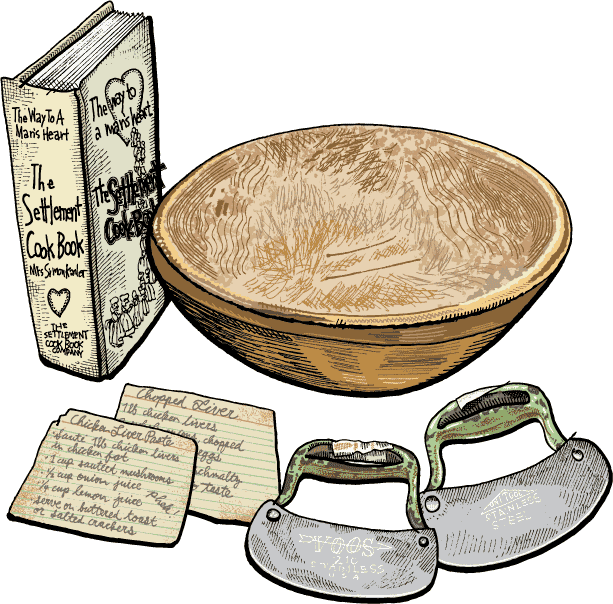
I cherish my grandmother’s copy of The Settlement Cookbook. It was one of century’s early “assimilated” American “Jewish” cookbooks, written for Jews, but not for keeping kosher. Like the bowl, it looks its age. It was used. A lot. The cover, faded and brown, torn completely off, is held in place by a stiff, faded blue rubber band. The pages are yellowed, thumbed through, rubbed and stained with years of cooking. Clipped recipes, folded and faded notes, are stuffed into the front and back covers. My grandmother’s handwritten recipes are scrawled inside the book. Some seem to have been almost washed away by an errant wet dishtowel, or a damp hand set down in the wrong place at the wrong time.
Just out of curiosity, I checked my grandmother’s copy of the book for chopped liver recipes. The closest it gets is a recipe for “Chicken Liver Paste” on page 316, (“pheh!” says Sara Kasdan’s ghost). It calls for sautéing chicken livers in chicken fat (OK, so far), and then mixing them with sautéed mushrooms, onion juice, lemon juice, chopping the whole thing fine and serving it on “buttered toast or salted crackers.” This is not chopped liver. This is some Americanized version. Fortunately, my grandmother didn’t need The Settlement Cookbook to learn how to make chopped liver. It was in her blood, in her heritage, in her head. She learned, I’m sure, from her mother, who undoubtedly learned in the town of Kupesic in Lithuania, who in turn learned it from her mother whose last name was Shapiro and whose first name I don’t know and probably never will. I do know that chopped liver was not invented in 20th-century American kitchens, Jewish or otherwise.
Jews haven’t always eaten chopped liver. It’s part of the “chicken culture” of the Eastern European Jewish community, developed during hundreds of years of the Eastern European Diaspora. No part of the chicken went to waste. Chickens did for Eastern European Jews practically everything that olive trees did for the Mediterranean. They provided not only meat, but feathers and cooking fat. (Of course this was in the days before cholesterol consciousness.)
But somewhere between Biblical times and our postmodern culinary kingdoms, Eastern European Jews started making and eating chopped liver. Checking the books, it seems clear that it has long been a part of Jewish eating routines. I discovered that the Friday night meal my grandmother routinely prepared week after week was the same one described by 19th century Polish and Russian Jews: chopped liver, chicken soup, roast chicken, potato kugel. Green Jell-O with pears must have been the modern-day addition for dessert instead of the more traditional fruit compote.
Check back tomorrow for the conclusion of Ari’s essay.


