
A Guide to Getting Good Rye Bread
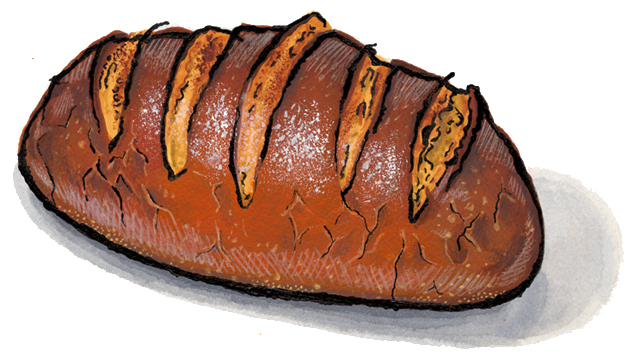
Reprinted from the Zingerman’s Newsletter, January-February 2009
Based on everything I’ve learned here’s what goes into a good Jewish rye bread:
#1 A Good Rye Sour Starter
The old style, Jewish rye starter is made by taking the previous day’s fully baked rye bread—what Michael and the bakers of the era in which he grew up used to straightforwardly call “old.”
The general wisdom of course is that the consumer can’t tell the difference. We’ve never agreed with that, and I certainly don’t think it to be true about the rye bread. But…. others don’t always agree. Michael told me the story of one of running into one of the guys whose family had one of the best old time Jewish bakeries in the City. To Michael’s taste though the bread wasn’t as good as what he remembers. So Michael, who’s rarely afraid to hold back his opinions, asked if he was still using the old style starter. “Na!” he said forcefully. “Nobody knows the difference!” And then, Michael went on, “He took out this wad of bills, waves it front of me says, ‘Remember Michael, this is your best friend.” Yikes. That’s a bridge I don’t ever want to cross. Keeping the rye bread and its crust and flavor intact is not a ball I want to let drop. There’s so little left—the Bakehouse is the bridge that people can walk over to cross back to the way that bread was when Michael was growing up!
#2 Use Rye Flour
To make a traditional Jewish rye bread we had to get back up to a decent level of rye flour. Roughly that seems to settle in at about twenty percent rye, eighty percent wheat. This is roughly the ratio that George Greenstein uses in his very good book, Secrets of a Jewish Baker, and it’s what’s worked well for us here for so many years now. (By contrast most commercial Jewish rye could have really no more than four or five percent!)
#3 Bake on the Hearth
To get the right texture of the bottom crust we wanted to bake on stone. This isn’t just a matter of nostalgia for stone ovens of days gone by.
#4 Steam
Steam in the oven is an essential part of the crust that makes good rye. Steam allows the skin of the “just slid into the oven” dough to expand as it starts baking, which keeps your crust from splitting open. Together the hearth and the steam work to make for a chewy, amber colored crust, that gives your jaws a work out.
#5 Time
More time for dough development means more flavor in the finished bread. We run what I’d guess is about twice as long for the rye at the Bakehouse as most commercial bakeries do.
#6 Flavor
The bottom line with Jewish rye bread is how it tastes. And it shouldn’t taste like white bread; not even white bread with caraway seeds. Rye has a deep flavor, a flavor of the earth, a flavor full of character, a flat feel on the back of your tongue that gradually fills your whole mouth. And it should be chewy, both crust and crumb should work your jaws. Yeah on a perfect day the crust should crackle. If a baguette is the high note of bread, then rye bread is the bass. Steady, delicious, never wavering, it’s rooted in the soil of northern Europe, its sturdy texture and lightly sour flavor provide the perfect pairing for a thick schmear of cream cheese or sweet butter. Good rye has guts. And it’s really, really good.


